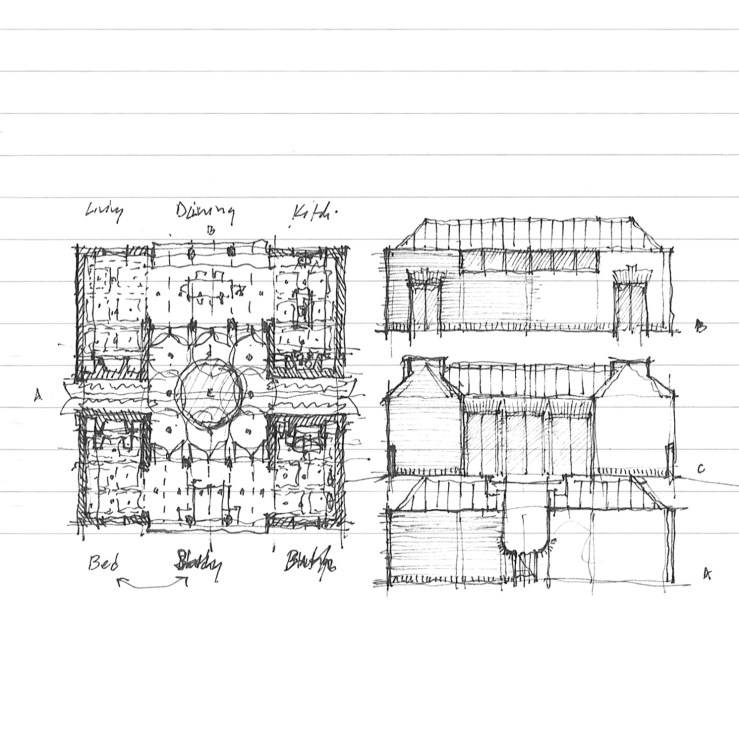
two halves and a courtyard

courtyard-house_06

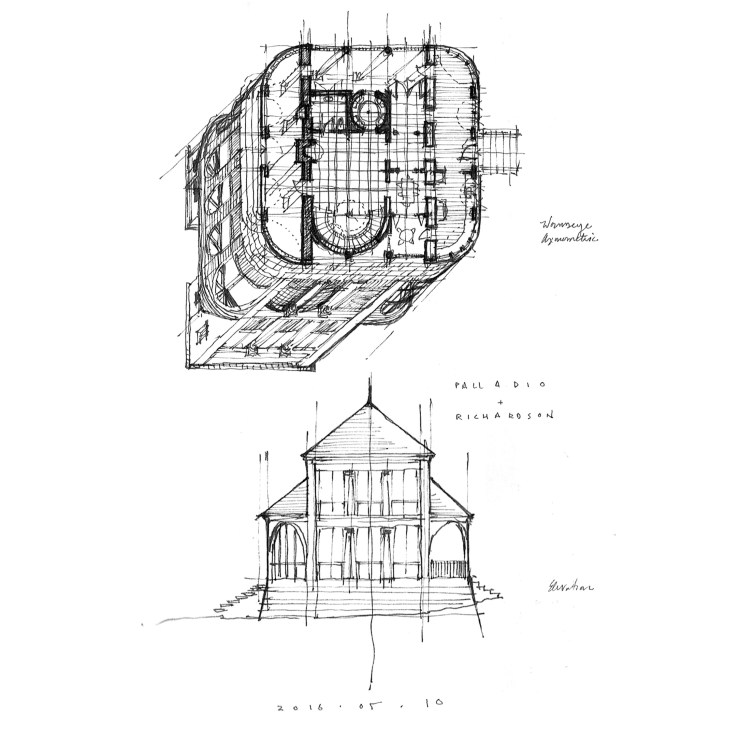
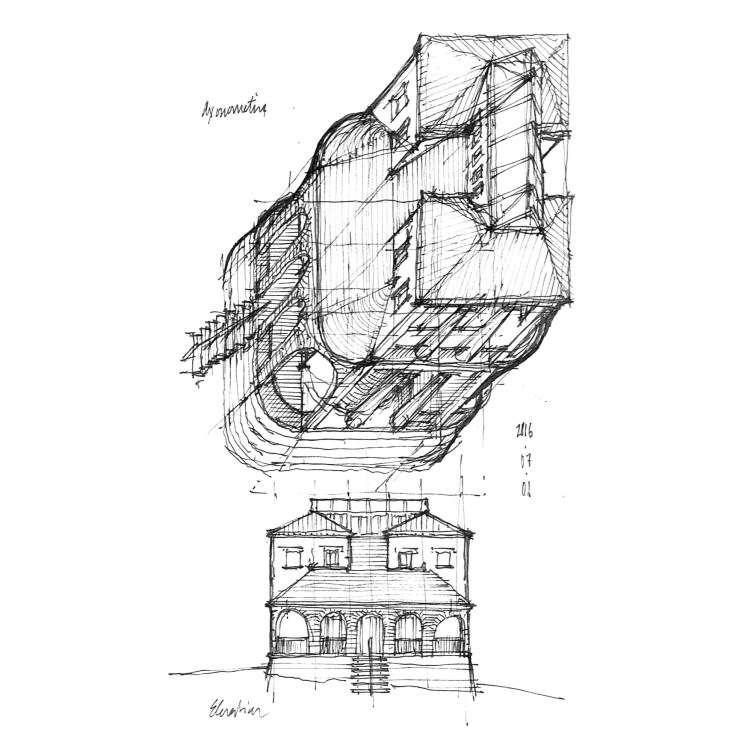
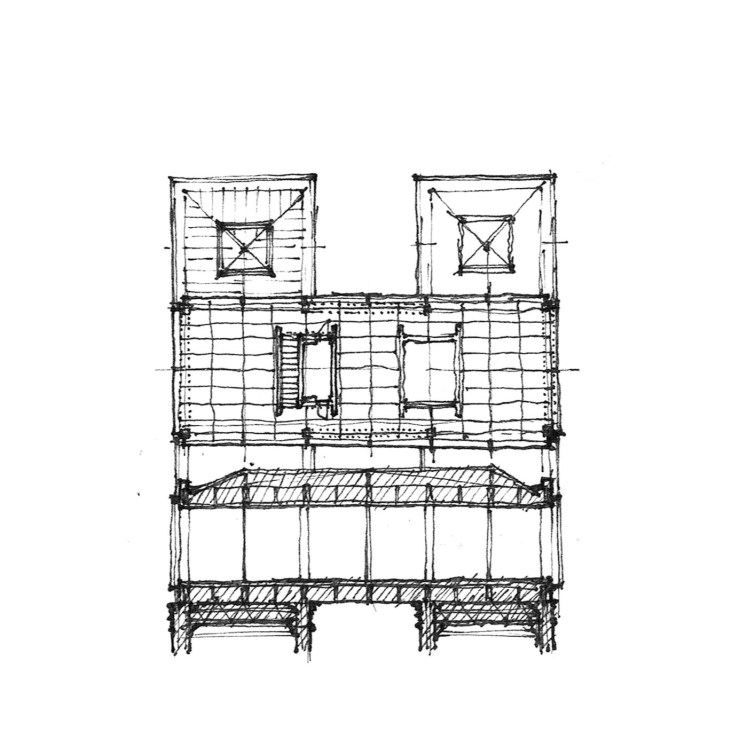
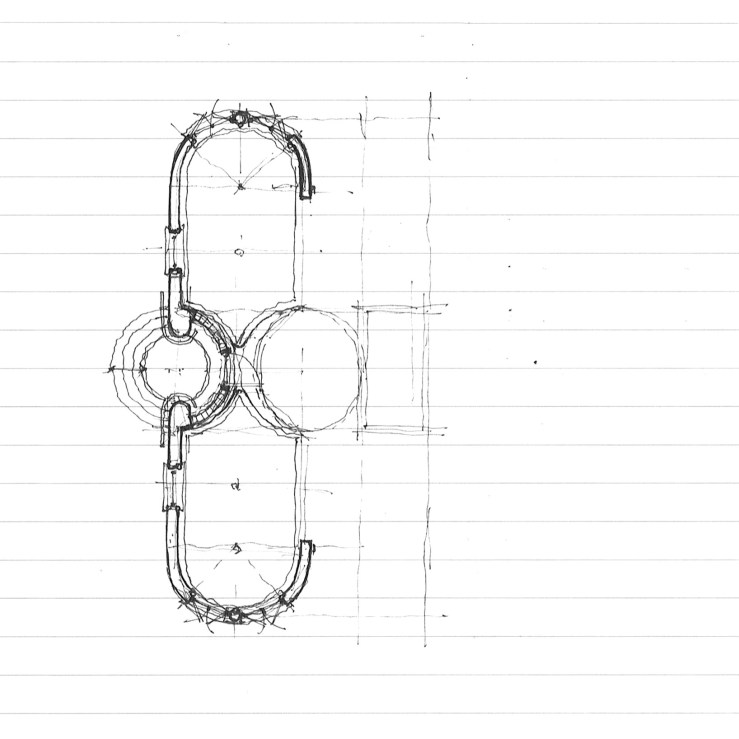
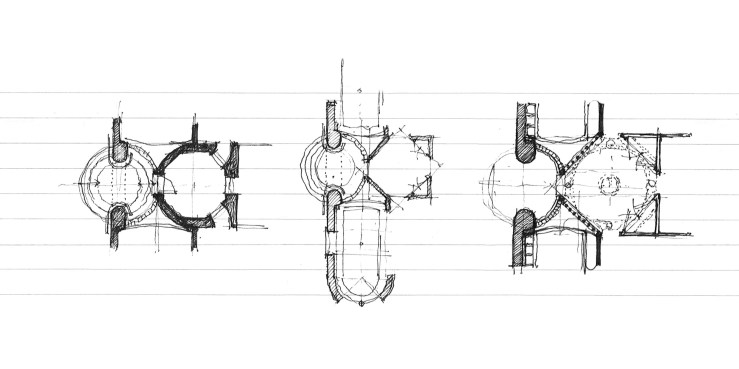
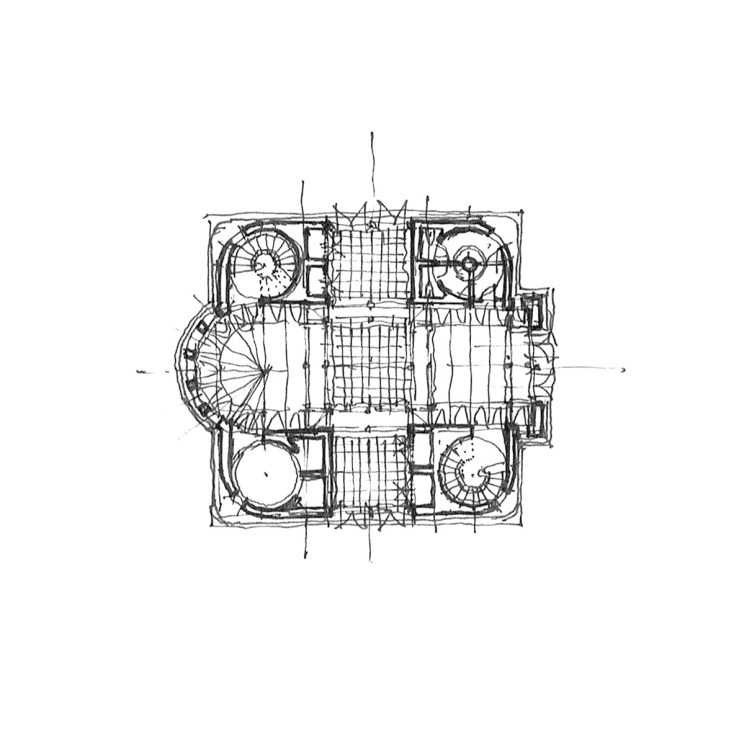
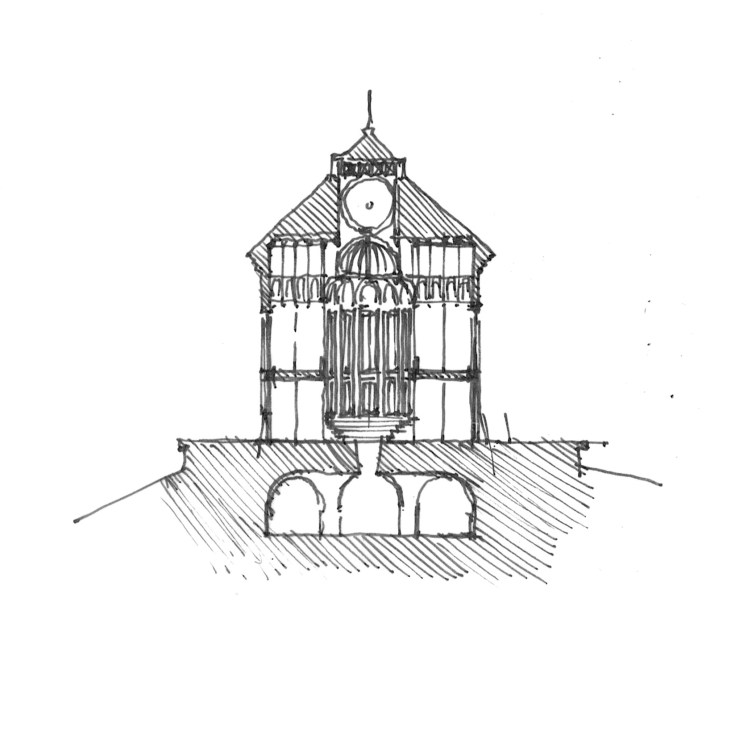
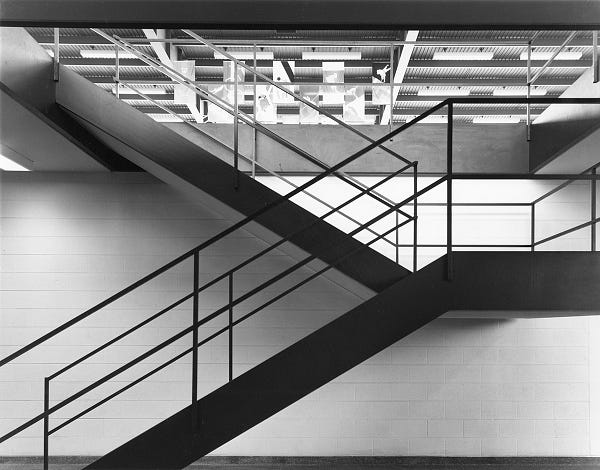
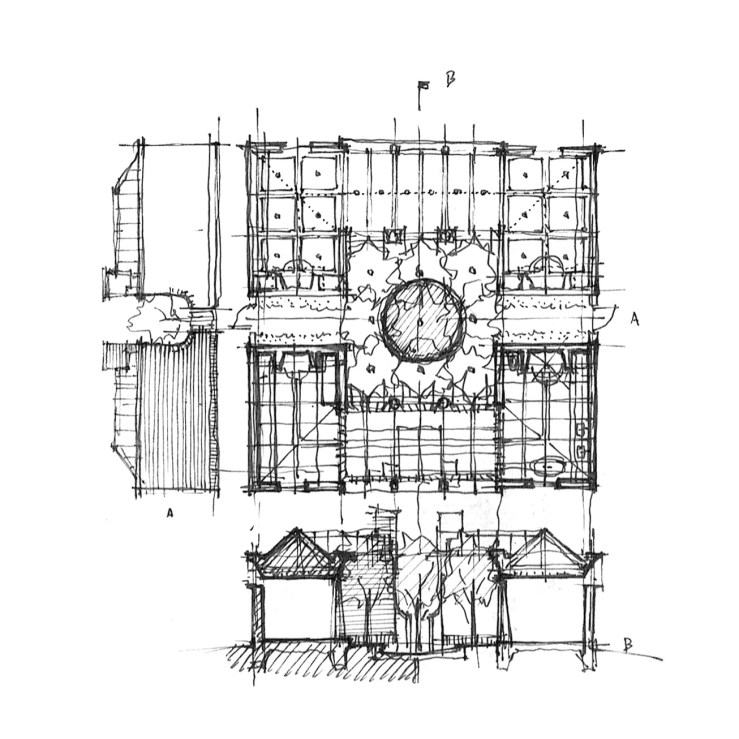
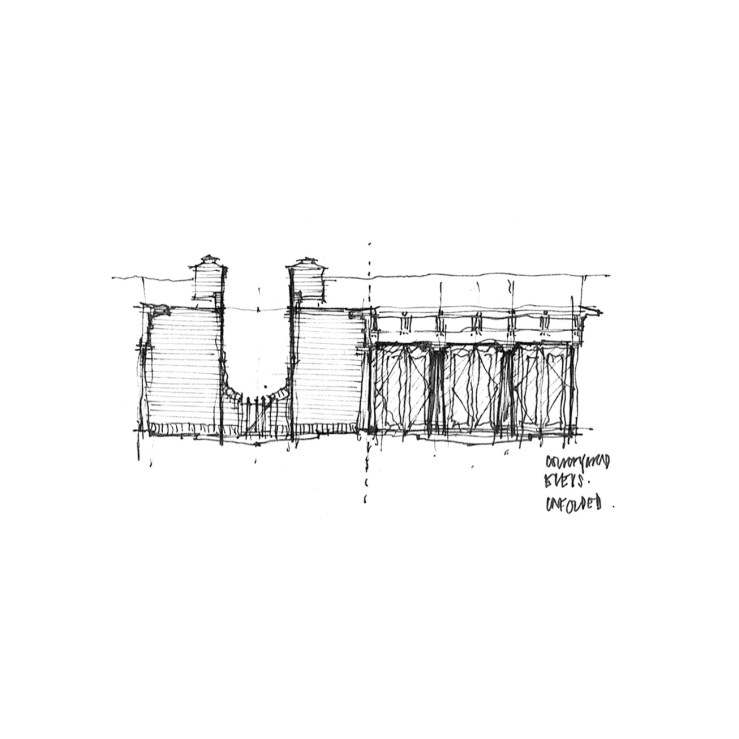
This small house is defined by the square courtyard at its center, which is filled with trees and a reflecting pool.  The form that wraps it is bisected by alleys, forcing one to ambulate through the courtyard to move between the halves. Further, no access is granted directly from the house to the surrounding landscape, making the courtyard the public entry as well.  Studies below explore rendering two of the courtyard faces in Doric form, opposed to the simple brick envelope at the exterior.
courtyard-house_07

courtyard-house_08

courtyard-house_09

courtyard-house_10

another cabin-thing

cabin_07

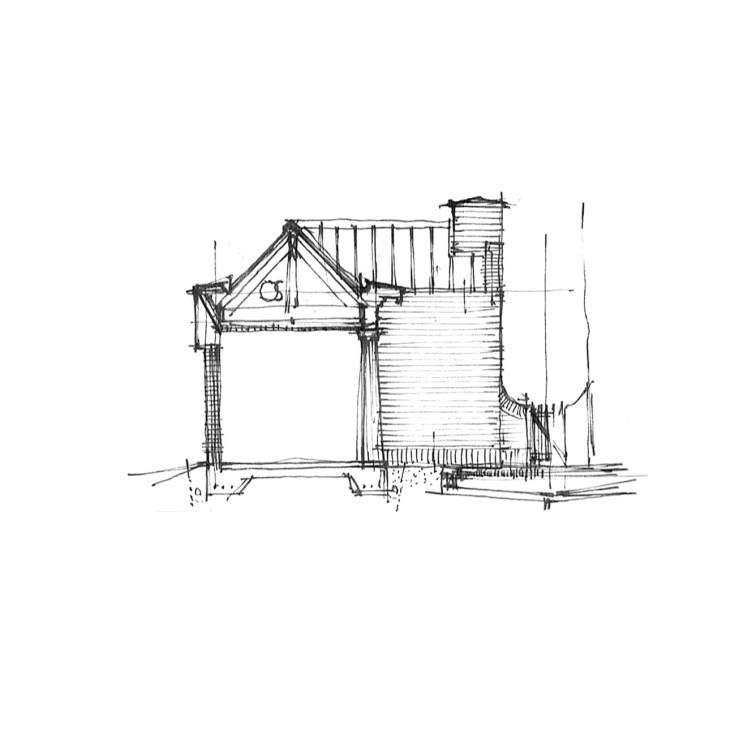
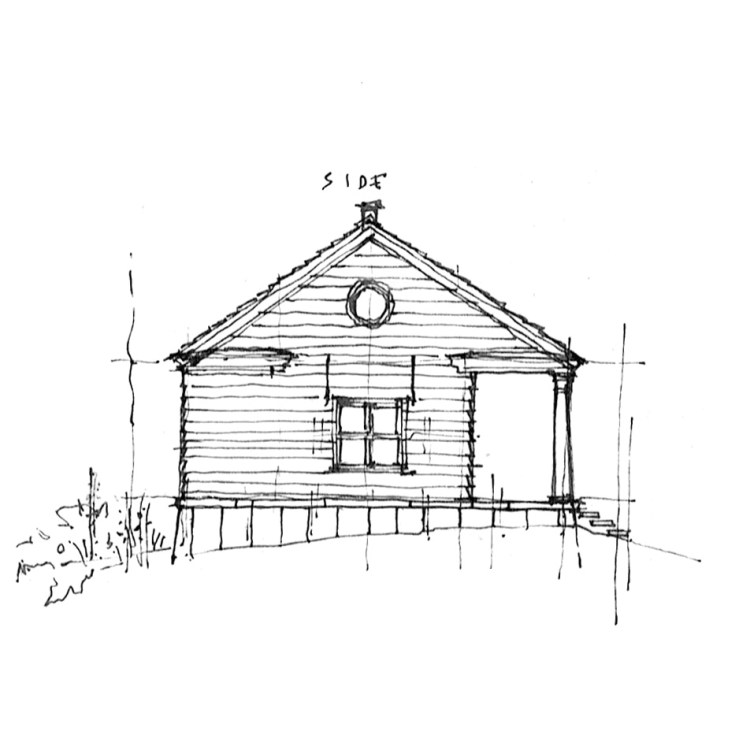
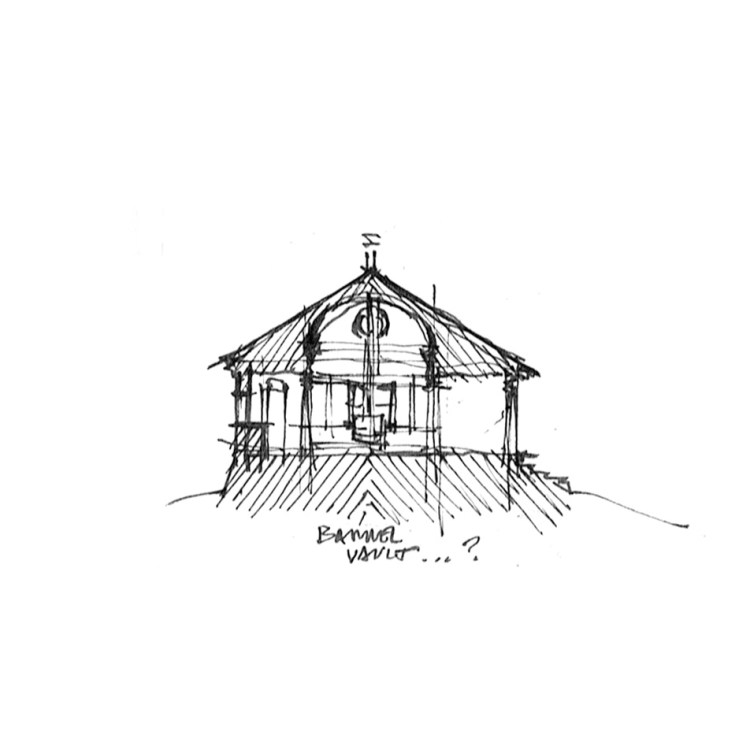
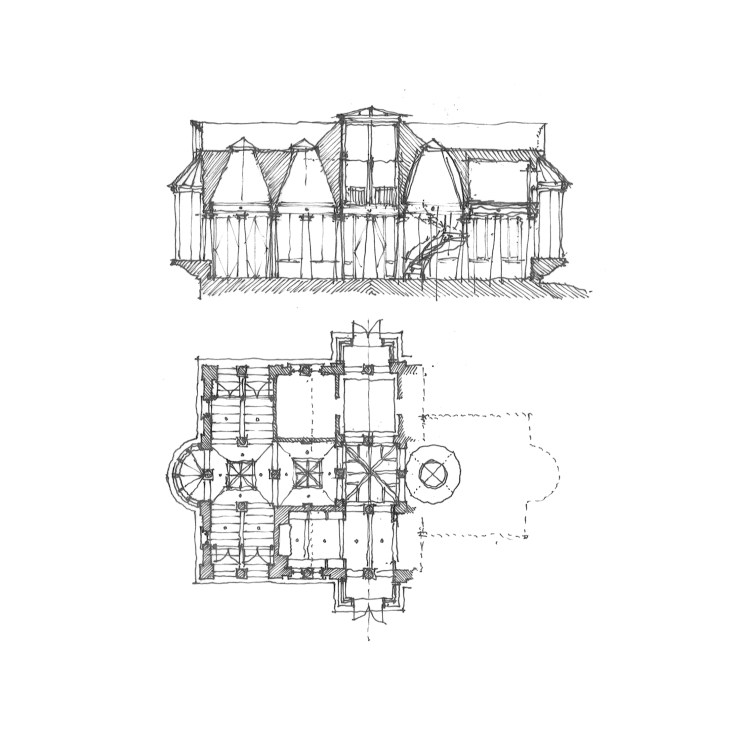
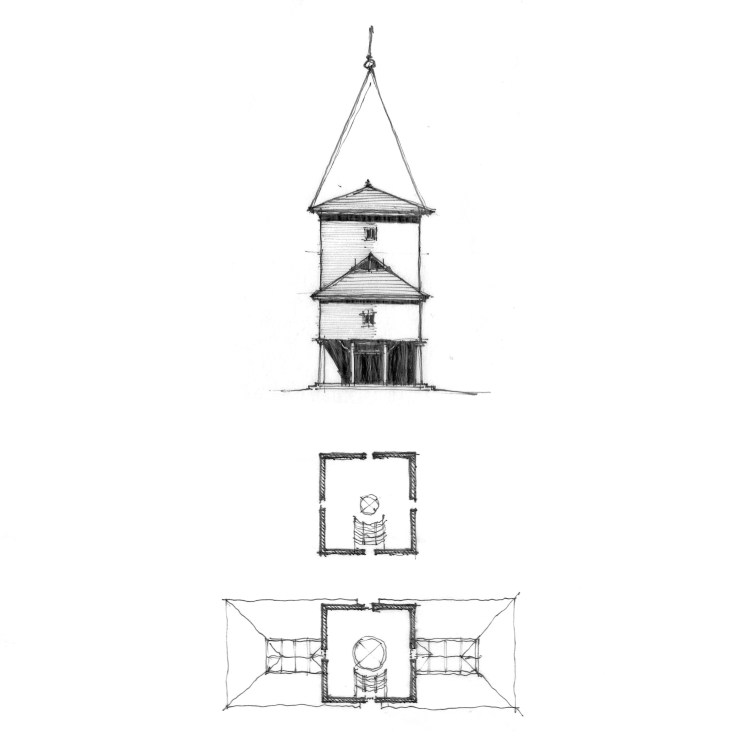
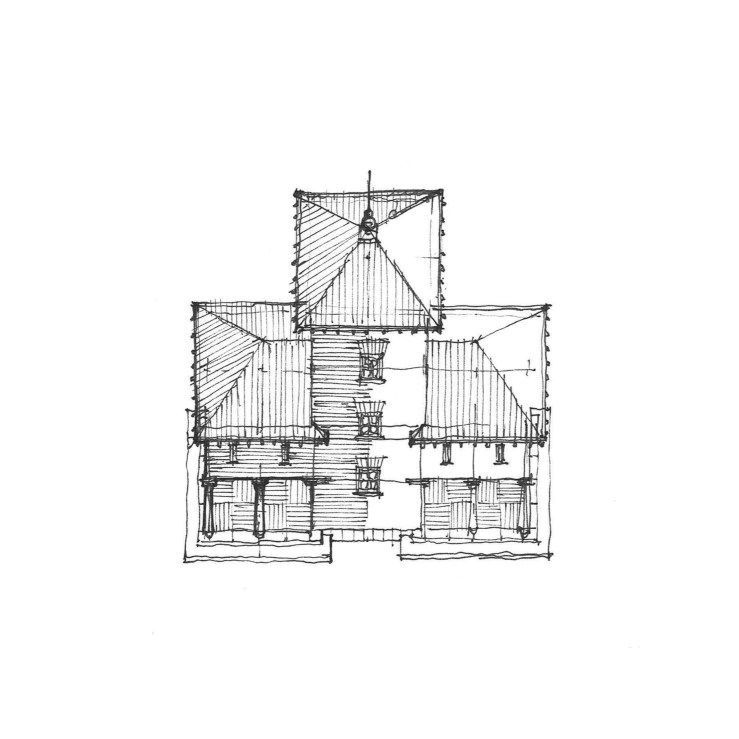
Continuing my exploration of rural agricultural form, this square cabin-like-structure plays on ideas of symmetry, complete and incomplete form, nine-square and four-square planning, all within the guise of simple vernacular architecture.  The side elevation was the generator, with an overall symmetrical gable, infilled below with a colonnade on one end, a blank wall on the other, and a large picture window on center.  The plan operates between the three bays of this side elevation and four running perpendicular, with a long vaulted living-sleeping room flanked by the porch-colonnade on one end and a long kitchen-toilet-service gallery opposite.  A study of potentially running a barrel vaulted ceiling the length of the main living hall is at the bottom.

cabin_08

cabin_09

cabin_10

cabin_11

nine-square staircase

two-gables_05

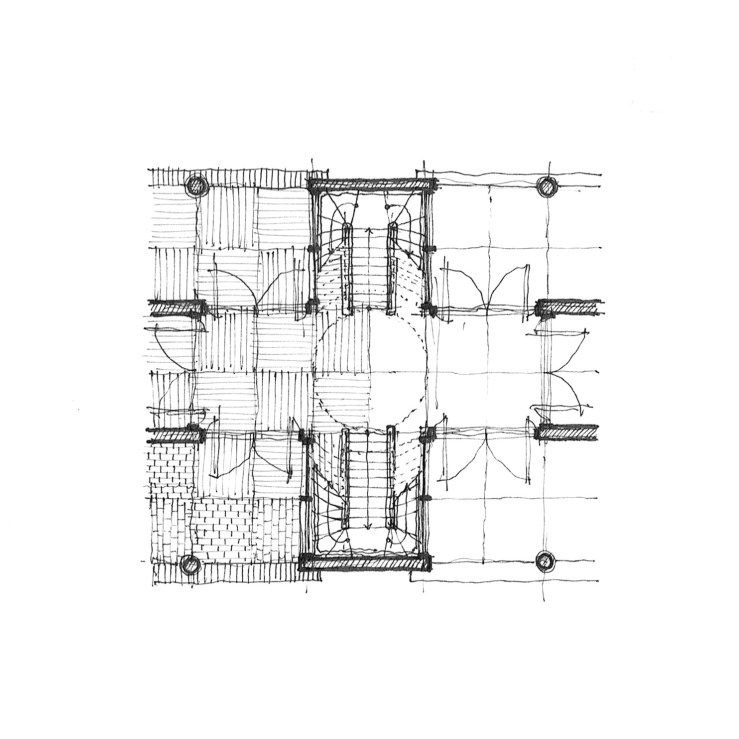
This is a piece of a larger puzzle, the basic parti of which is sketched above.  The stair is located centrally in the square plan, and is itself a nine-square plan.  Tectonically, the stair is supported on a peristyle of Tuscan pilasters, while the stair proper is takes its details from Mies’ Crown Hall at IIT, and tall fireplaces occupy three sides (their form, a take on Schindler’s Kings Road House.

two-gables_04

two-gables_03

double gables

two-gables_01

This house plays a game of symmetry, where the magnificent double gable of Lutyens’ Homewood is played on every facade, but punches out by one module on the east and west facades.  The stair is set off-center, with a tall square atrium (Craig Ellwood of two posts back), and an asymmetrical collage of symmetrical rooms inside.  My first plan (above) had double columns throughout, the second plan (below) favors the single centered column.

two-gables_02

a market hall

MARKET_01

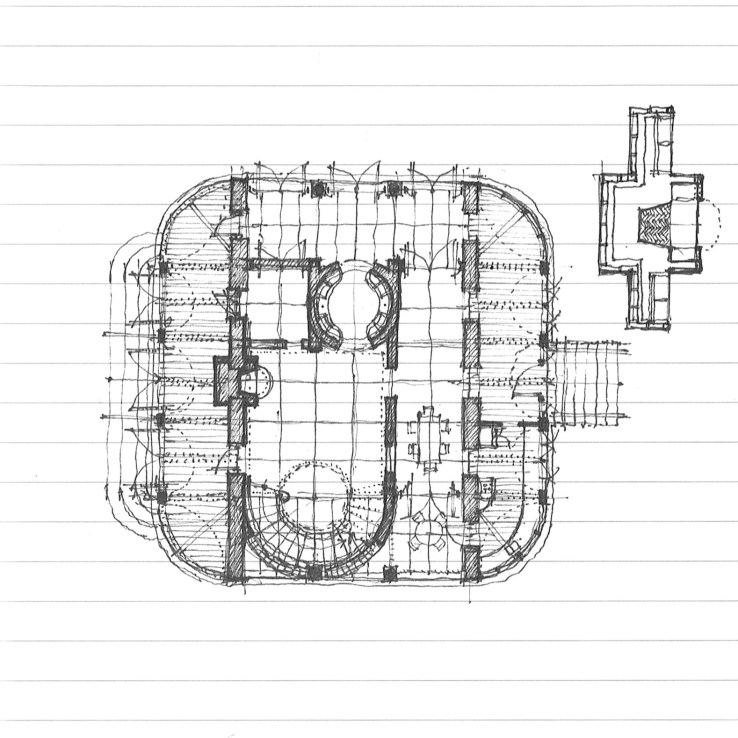
This is a collection of market types, with four ancient Greek stoae on the ground level, double stairs up to the second floor market halls, skylit, and further to the commodities trading levels within the tower.  An atrium spans between the four levels.  An enlarged plan of the entry lobby finishes the drawing set.

MARKET_02

MARKET_03

MARKET_04

shingles and palladio


VILLA_06

A Palladian villa facade on the primary axis is countered with long, low shingled porches on the transverse, which in a twist of irony is where the entry is located.  Behind a symmetrical elevation of colonnades and porticoes, the building takes a more free spirit – one porch is exterior, the other ‘enclosed’, a glass-wrapped stair hall occupies two of three bays of a frontal portico, while the left over bay is screened in.  The shingled roofs of the porches extend to meet a long skylit lightwell, cutting the central Palladian volume in twain.

VILLA_05

VILLA_07

a bridge house

BRIDGE-HOUSE_01

frame is back in town.  So let’s get started: two classical brick pavilions sit under their modernist counterpart, divided by a long driveway, forming a nine-square plan.  While the first story bars quote Bruce Price’s library at Tudedo Park, the second story harps on Johnson’s Glass House in New Canaan.  Details follow.

BRIDGE-HOUSE_03

BRIDGE-HOUSE_02

a cottage villa

COTTAGE_07.jpg

A square with Richardsonian towers on the corners, flat masonry facades in the main axis, with full-height shingle roofs over porches in the other.  A skylit circular stair in a square hall in the center with octagonal-ish foyers on either end with half-round aedicules for entry porches.

COTTAGE_03

COTTAGE_09

COTTAGE_05

COTTAGE_04

basilican explorations

CHURCH_16

As I was writing this post a few weeks ago, I found the plan to be once again worthy of some further reflection and thought – precisely the nine-square plan, with a hybrid basilica and greek cross interior volume, the four empty corners filled with circular forms (bathrooms and stairs) encased in heavy poche, and all of it wrapped in a brick Richardsonian wrapper under a singularly simple red tile hip roof.  The bottom iteration was the first, while I was still wrangling the plan into a perfect nine-square.

CHURCH_17

CHURCH_18

CHURCH_19

CHURCH_15

yet another basilica

KIRCHE_03

O. M. Ungers and Richard Meier play the primary instigators in terms of language of this basilica – minus the Doric impluvium entry courtyard, of course.  The front elevation/plan drawing shows shadows that hint at both wormseye and oblique axonometric projections.  Structure and tectonics play a central role where pipe and wide flange columns slide back and forth next to one another, while small circular side chapels cut into the deep poche of the stone walls.

KIRCHE_04

KIRCHE_01

KIRCHE_02