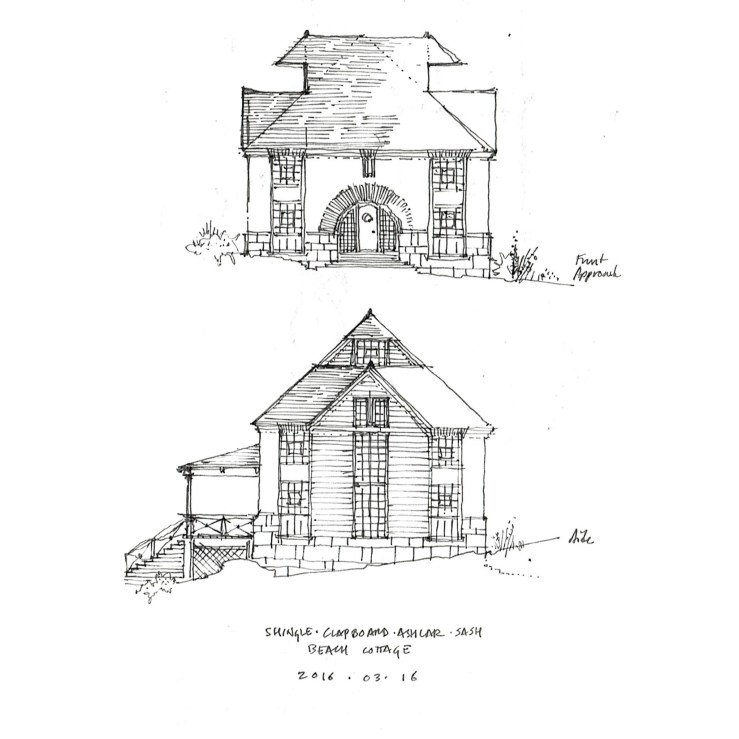
a beach cottage

COTTAGE_01

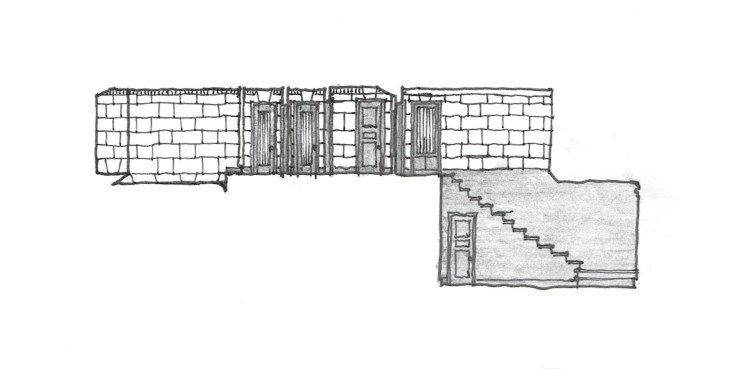
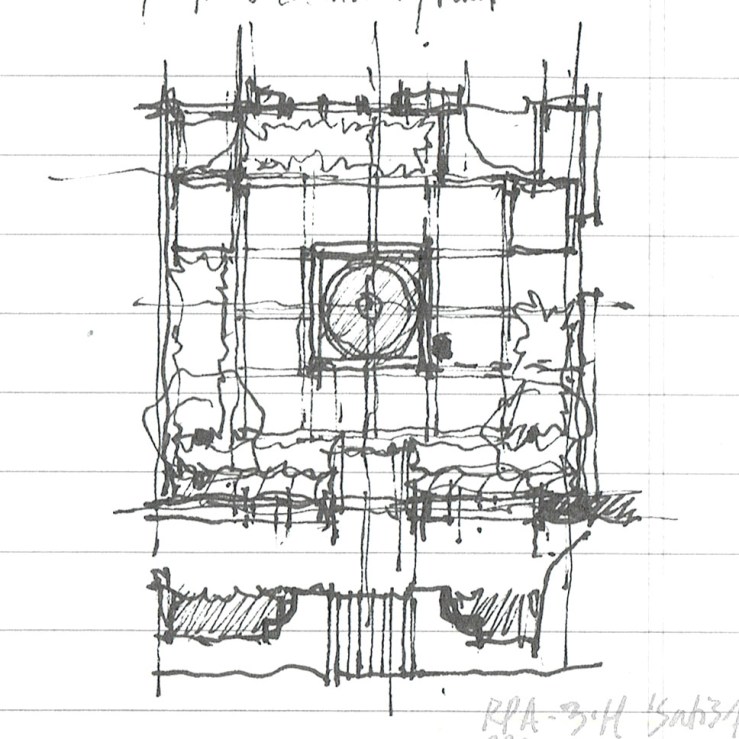
Taking cues from Shingle Style residences mixed with a fair amount of Richardson (red mortar on Flemish-bond brick and rough-faced ashlar masonry much?) and a bit of my own preferences for industrial sash windows and rigid geometries, this little cottage is organized around a nine-square plan, with cramped interior rooms and no central ‘Hall’, thereby favoring the large screened porch at the rear.

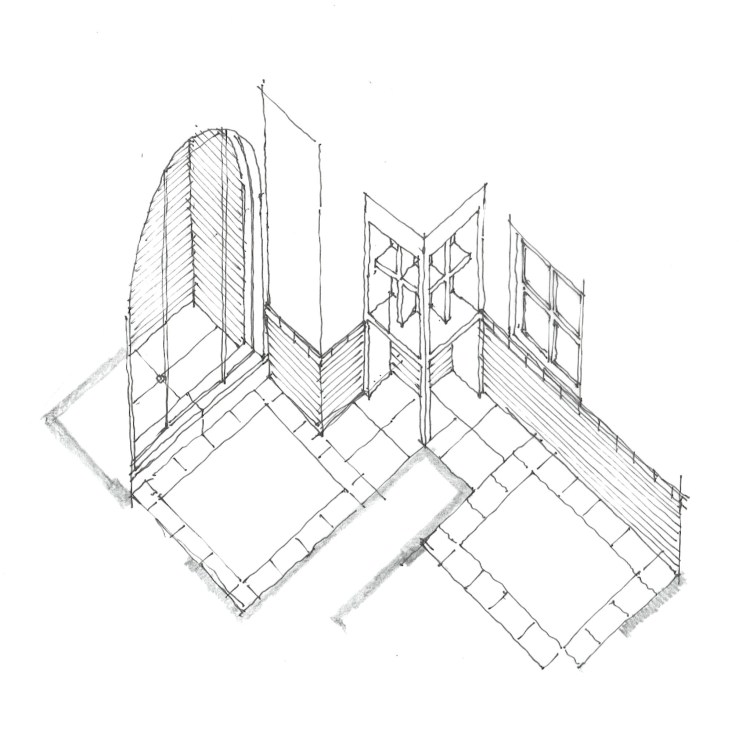
COTTAGE_02

me, myself, and mine

BATHROOM_05

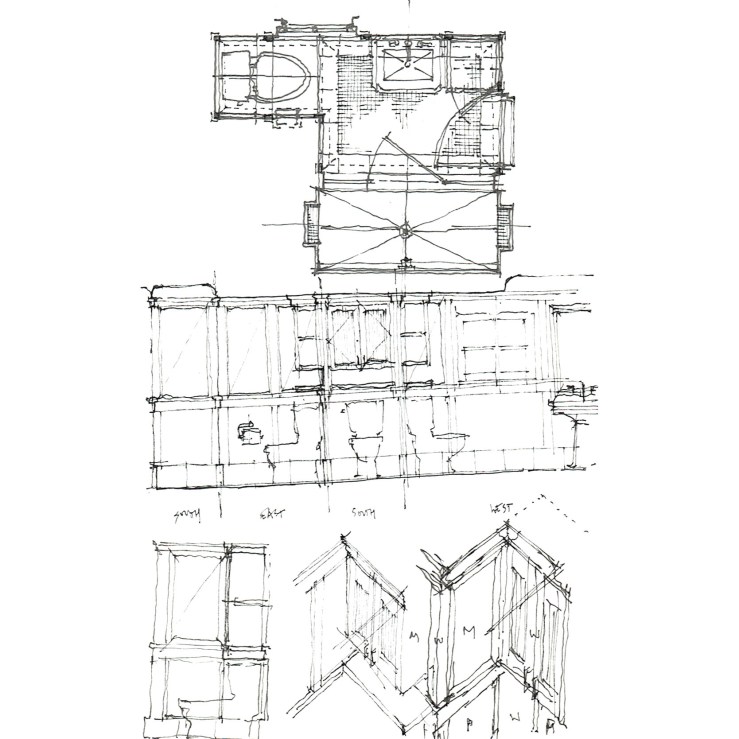
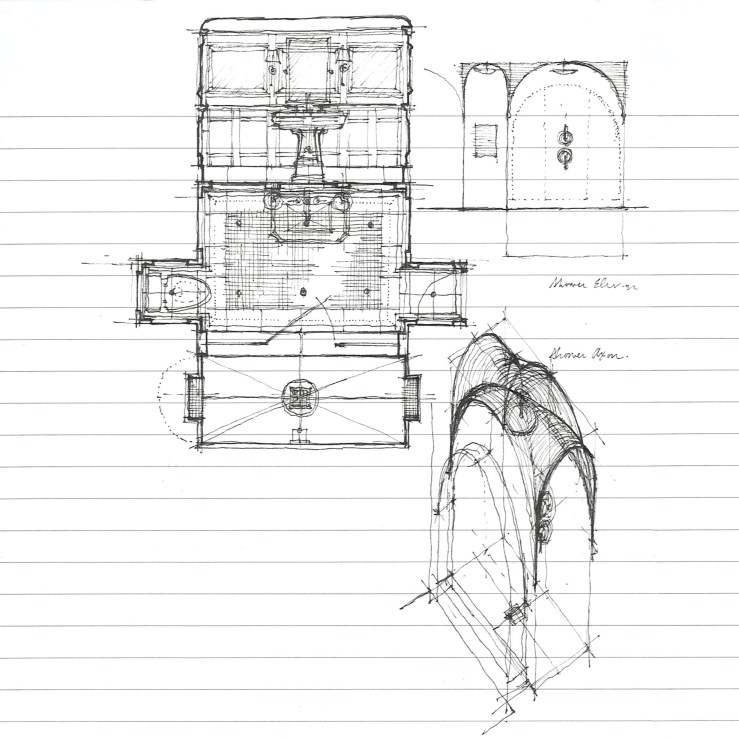
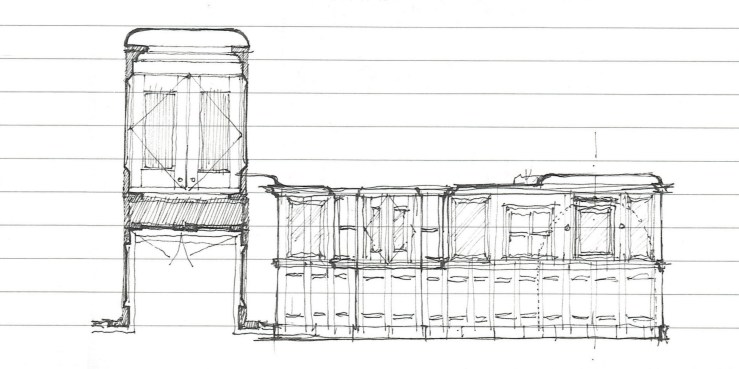
Today is the day I celebrate my birth into this crazy world.  So I’ll take this time to share some personal drawings: my house, or rather the little nooks and crannies of it that I’d like to alter, shift, sheathe, or paint.  There’s a lot of me here, my confusion, my interests, my unrest, as well as where I sleep, read, eat, and otherwise live.  There are bathrooms (above and just below), staircases (below), ceilings (below), gardens (bottom), and wainscotts throughout.  Enjoy.

BATHROOM_01


BATHROOM_03

BATHROOM_04

BATHROOM_02

260-MV_02

RCP_03

RCP_01

RCP_02


GARDEN_01


butterfly roofs and stuff

VETERAN_01

This small project is a riff on a diagram I’ve been working on at work, but taken to a polemic state.  It’s a single volume, capped with an inverted gable ‘butterfly’ roof, clerestories all around, with a walled-in porch at the public entry and a covered patio at the rear.  The drawings below show what happens when this prototype engages with additional forms to make a more complete residence.

VETERAN_02

VETERAN_03

shingles, squares, and circles

HOUSE_03

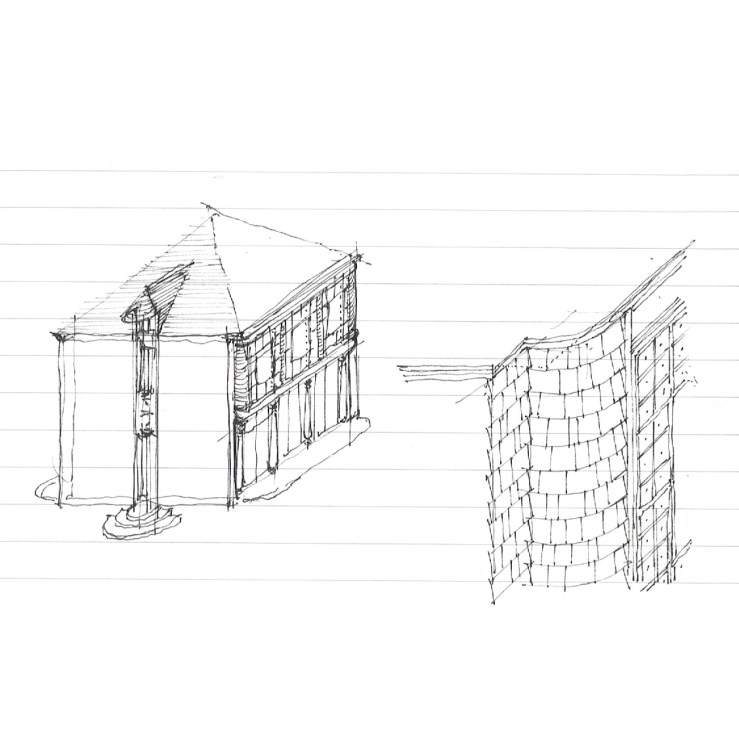
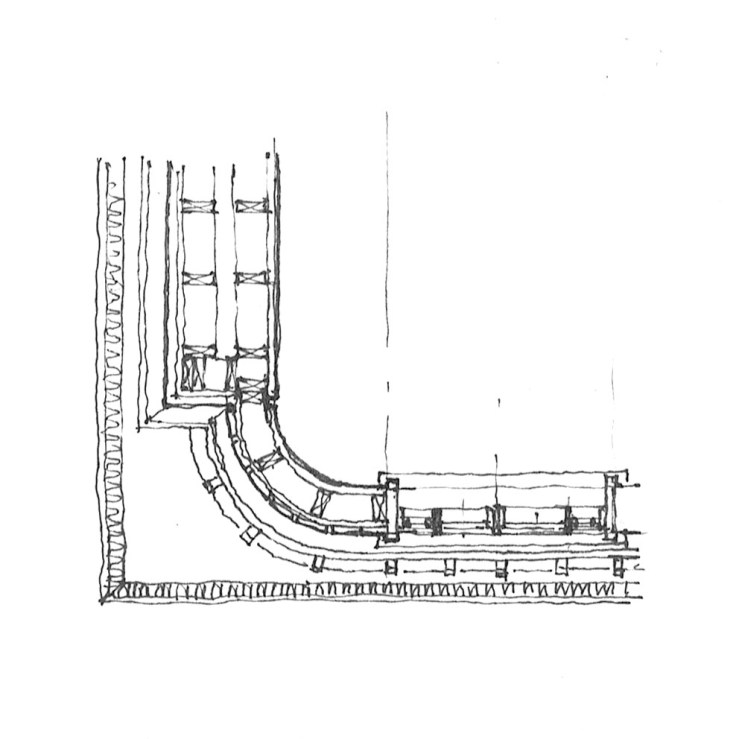
Let’s start with the detail this time, reading top to bottom: 1.) A shingled wall curves in to meet a stucco wall in a re-entrant corner.  Square windows are cut from this, mullioned into the four-square, with small, beveled squares around.  2.) This shingle wall is the second story with a colonnade below, the stucco is an otherwise blank wall, with only one tall window cutting through the middle and terminating in a dormer at the roof.  3.) This tall window only hints at the circular interior volume behind, one side a stair, the other an entry.  Other than that, no record of the two wall systems is traced on the interior, where only the radius of the curve exists.  4.) And just like that, we’re back at the detail again.

HOUSE_04

HOUSE_05

HOUSE_02

a gas station and the california vernacular

GAS-STATION_02

Driving along the coast through Laguna Beach, I noticed a funky little structure now operating as the offices for a small auto repair shop – it was clearly an old gas station, with the concrete pump pads still extant, which I’ve drawn in the top-most drawing.  The fascinating bit was that the overall building was a  gabled Spanish stucco hut, complete with a red tile roof and chimney, but the service awning was a flat modernist roof, and which cut deep into the gabled volume.  The overlap and simultaneity of languages was so simple, irreverent, and playful.  So I did my own variation: the plan is the bottom half of the top drawing, the half-elevations are below.

GAS-STATION_03

something stern did

RAMS_04

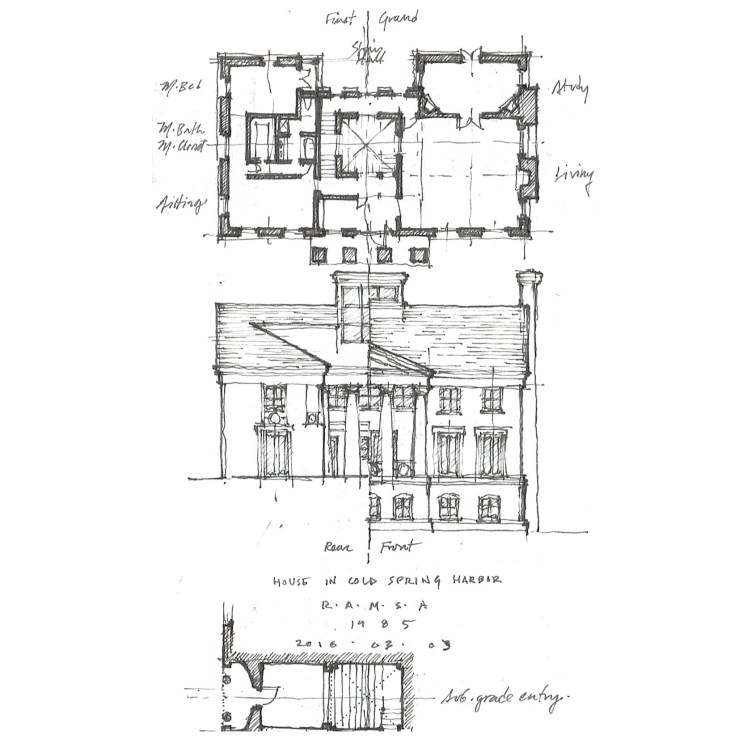
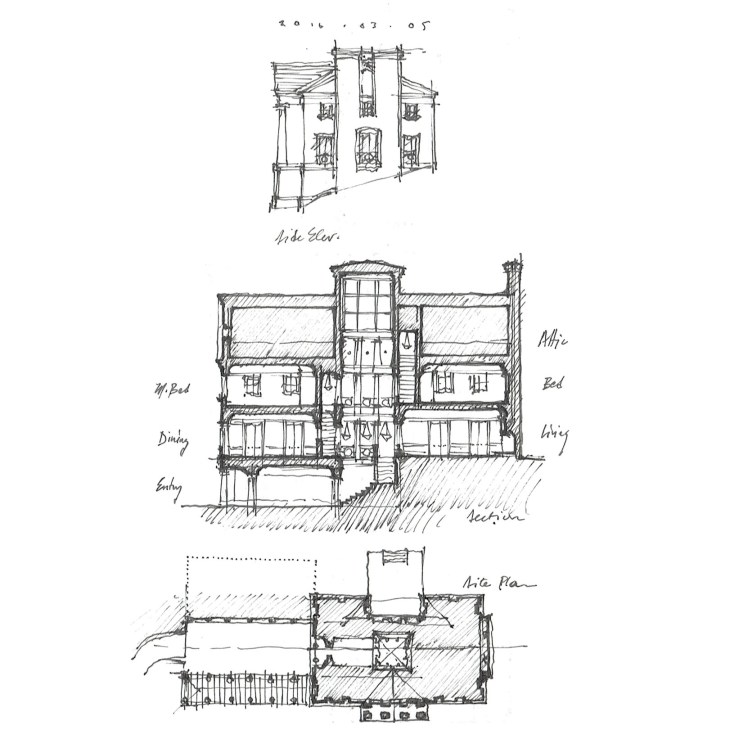
Stepping back to a previous topic, I’ll share an unbuilt Robert A. M. Stern project I stumbled upon a few months past titled simply ‘House in Cold Spring Harbor’ from 1985.  The house in interesting for a few reasons: the formal entrance is off of a motor court on the secondary axis, and is below grade (the bottom sketch in the drawing above); a large square stair makes up the majority of the central volume, and is capped with an enormous north-facing monitor; there is a wonderful play between the formal portico-ed facade and the rear garden facade, which takes on a u-shape; a large chimney-piece makes up the east facade, though the flue is not centered on the entire building, rather a window.  My own circular take on the central staircase follows.

RAMS_05

STAIR_02

from mies to wright

FLW_02

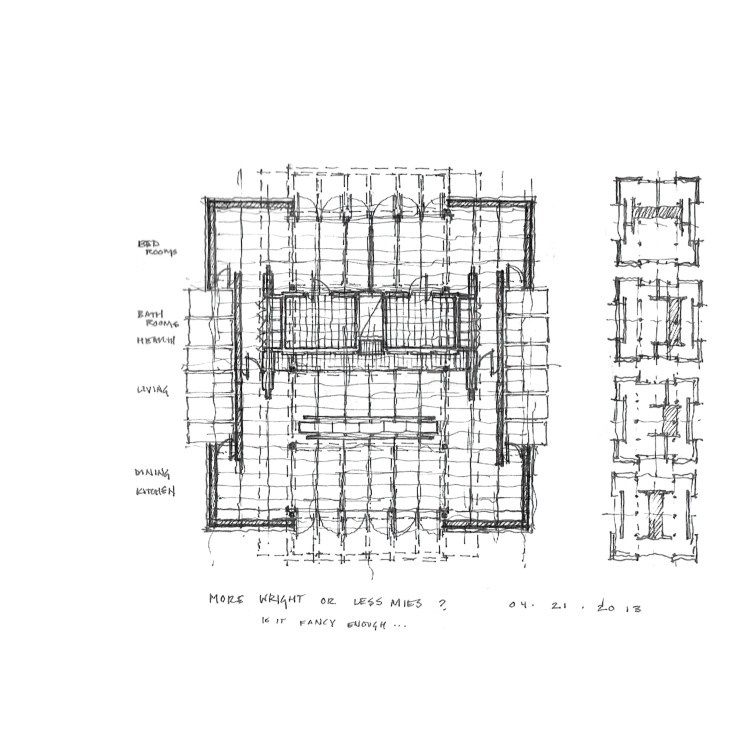
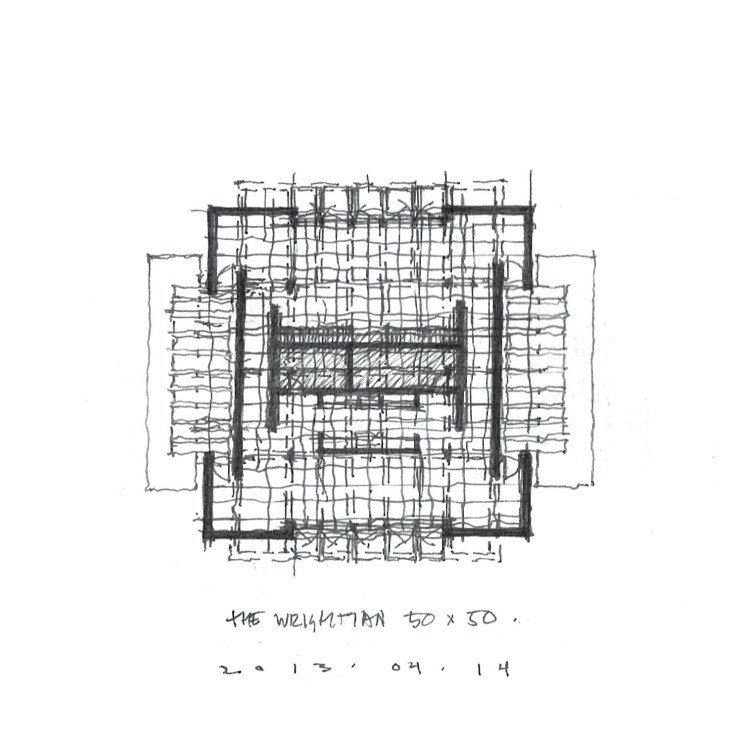
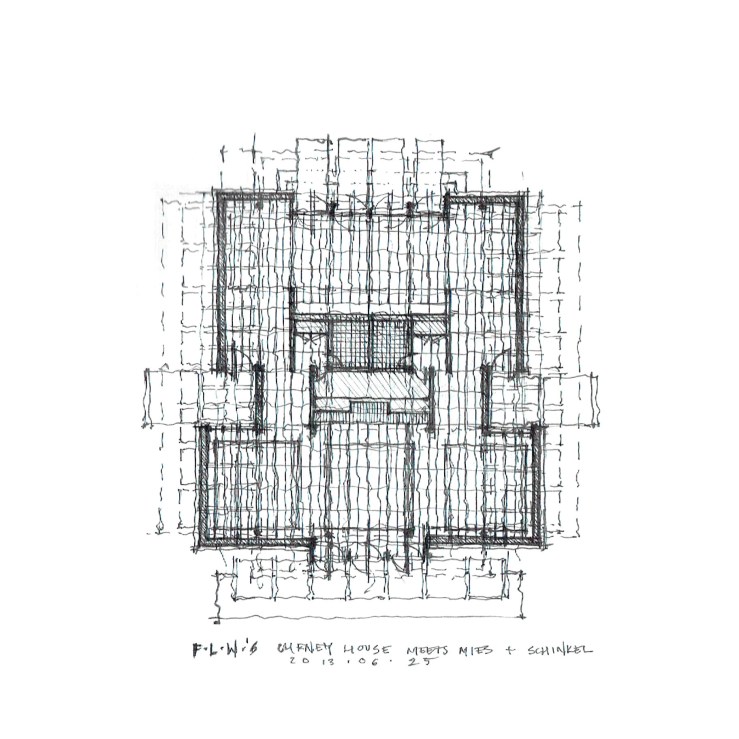
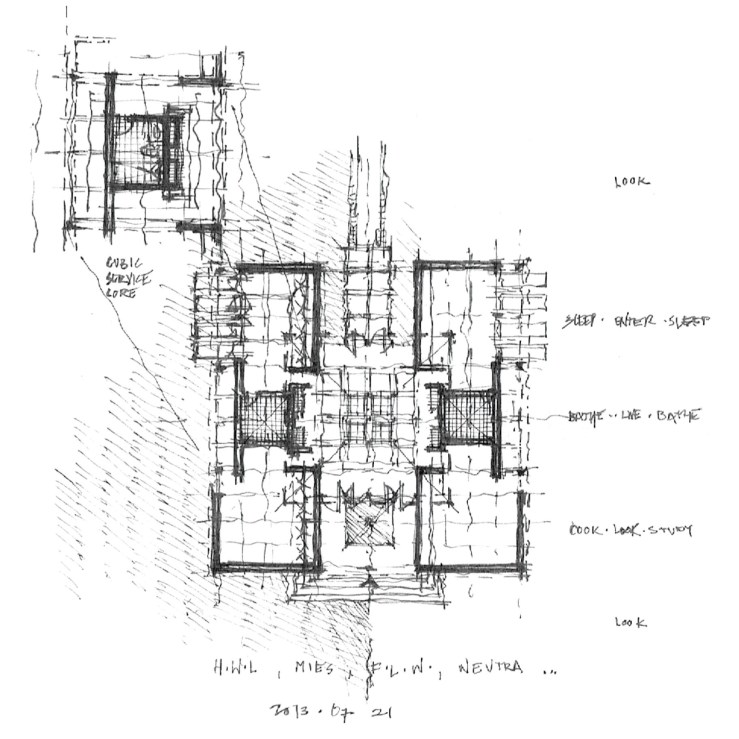
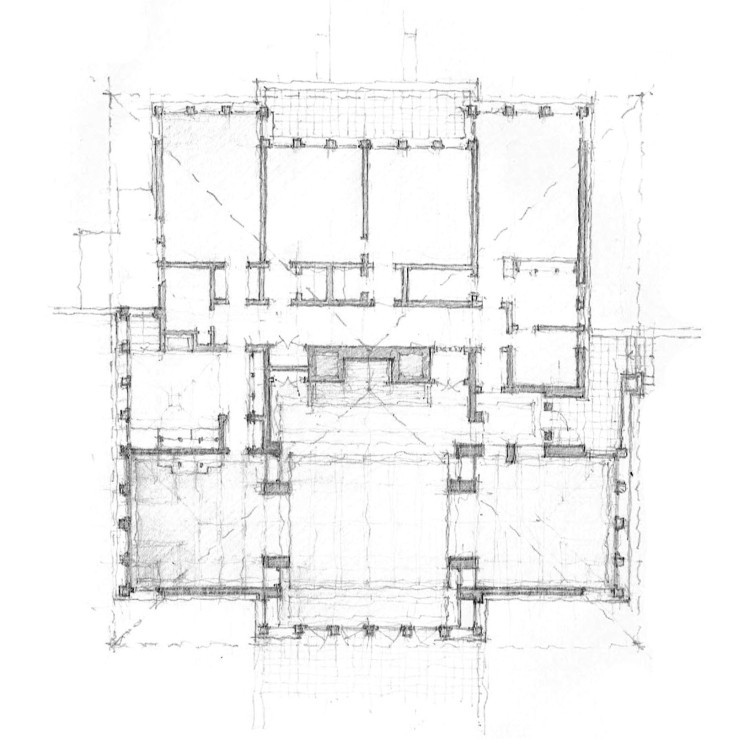
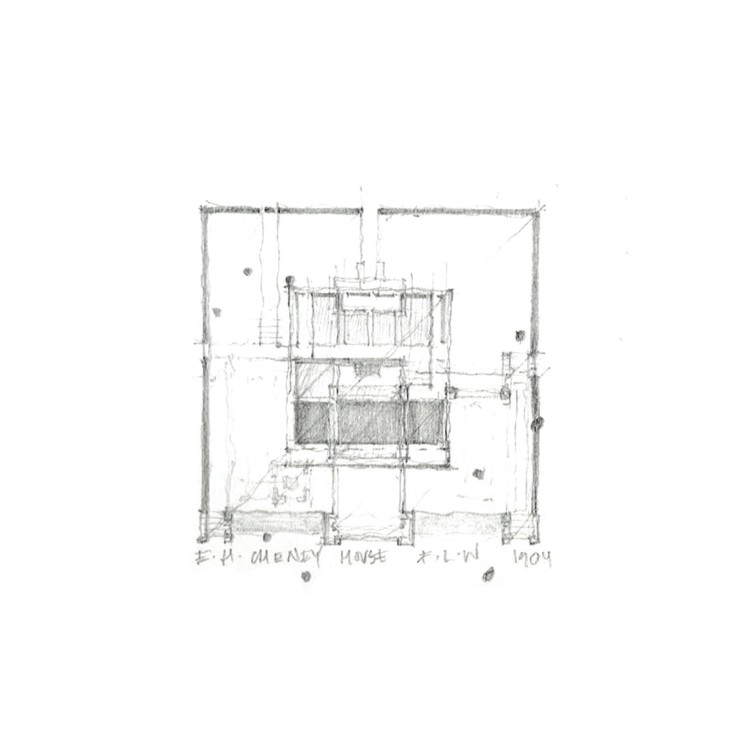
Keeping the Chicago theme, but moving a bit back in time, today I’ll feature some early Frank Lloyd Wright, particularly the Cheney House in nearby Oak Park.  The plan is fascinating because it is an effectively square structure under a large hip roof, divided into two halves: the front is made up of three public rooms (nine square), while the back is broken into four bedrooms (four square), with servant spaces filling out the middle.  The hearth is at the very center of the house, typical Wright.  This basic parti (formal planimetric diagram) still fascinates me to this day – a simple form with a complex, yet brutally clear interior logic.  The variations it inspired will follow over the coming days.

FLW_03