cabins & courtyards

courtyard-cabin_01

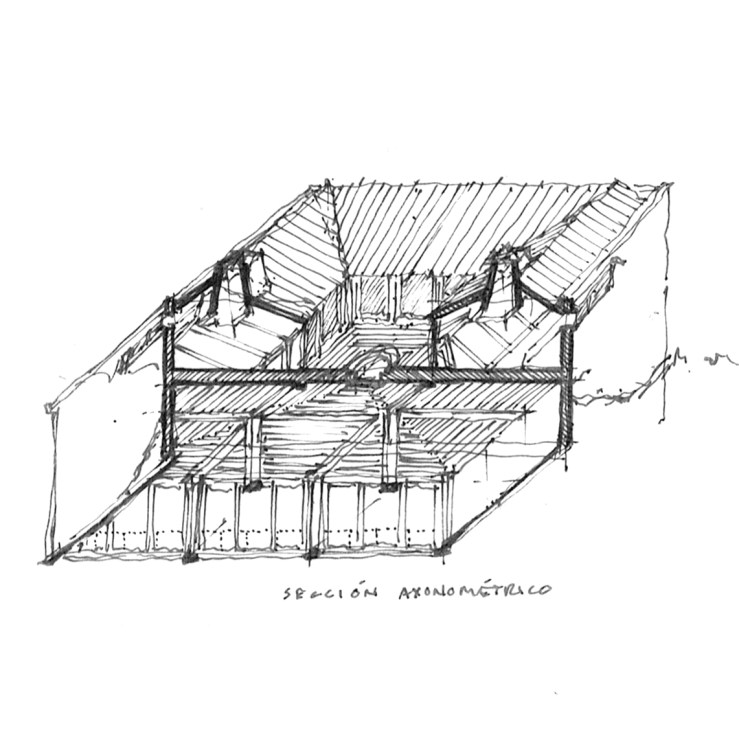
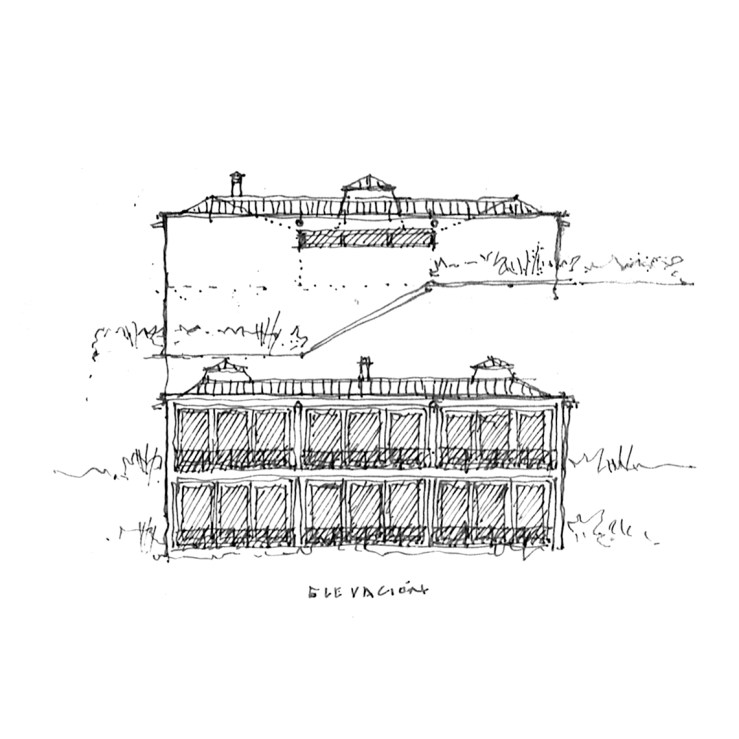
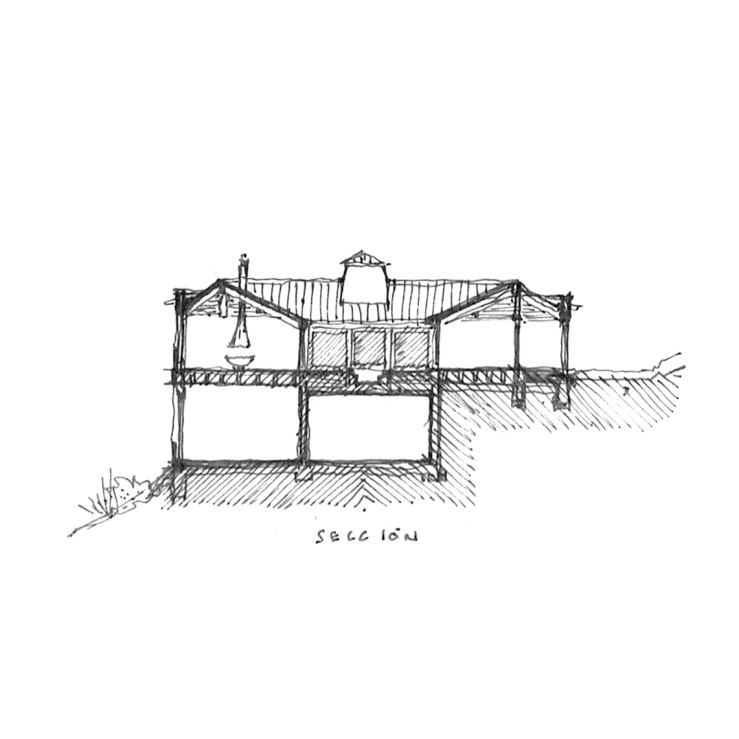
As a part of my Christmas traditions, my family and I spend a weekend in the mountains here in Southern California, where we can play ‘winter’ and ‘snow’ and safely return to our warm weather when our fingers are sufficiently numb.  The so-called ‘cabins’ we stay in are often over-sized log mansions, and kitschy as can be expected.

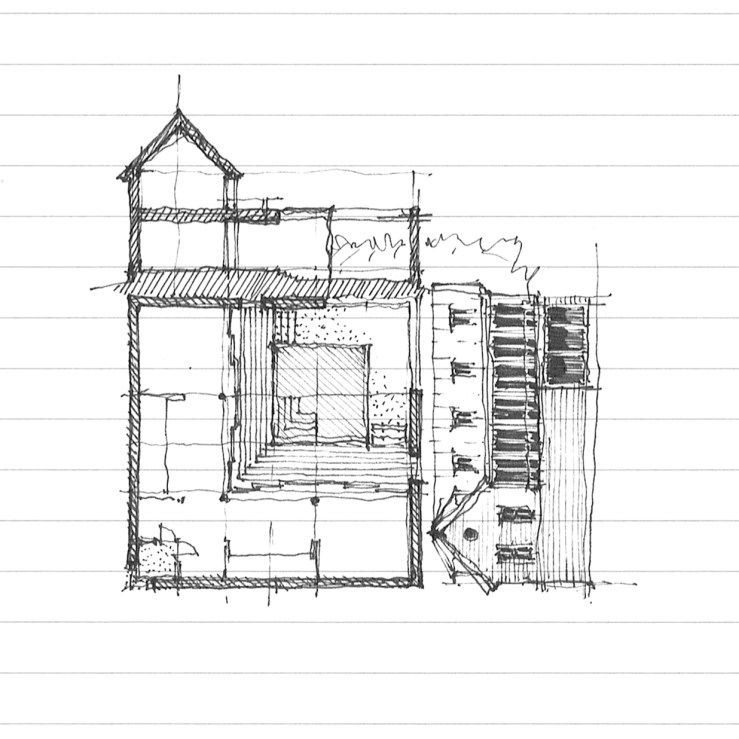
This project is an answer to them: a simple nine-square plan with a central courtyard, and a circular infinity-edge spa at the middle; the kitchen-dining-living trio lines the north edge, with sliding glass walls fronting a supposed lake view; and private sleeping quarters located on the lower level.
courtyard-cabin_02

courtyard-cabin_04

courtyard-cabin_03

square church, once more

square-church_06

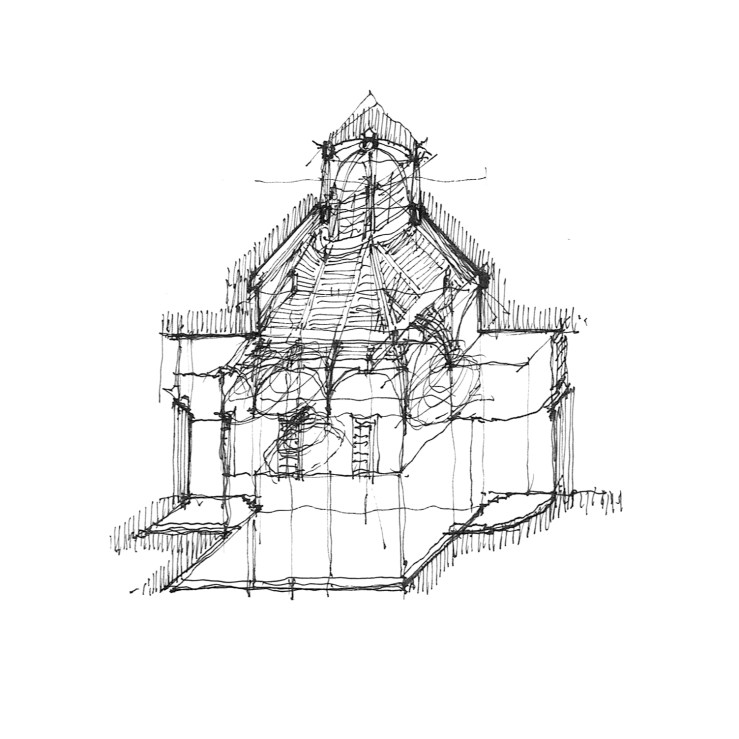
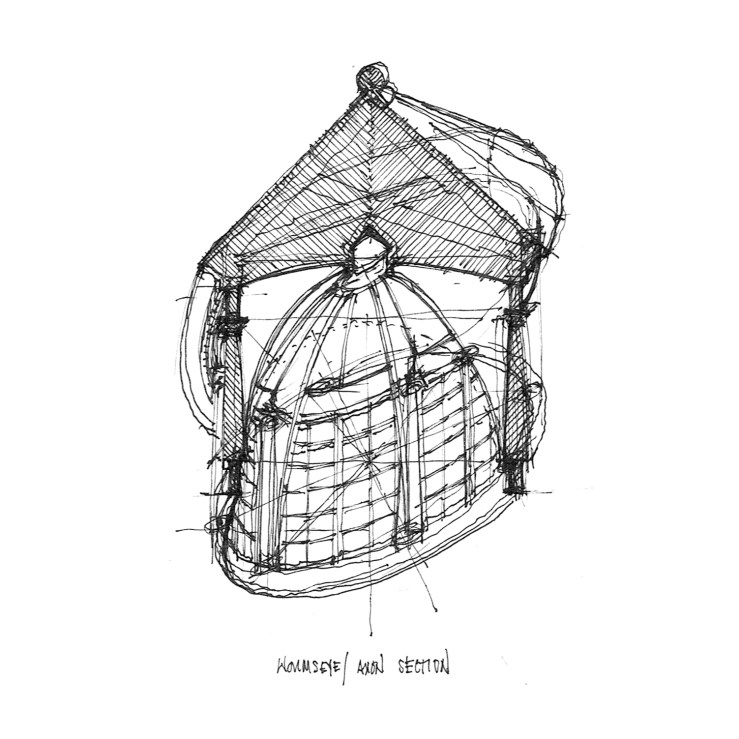
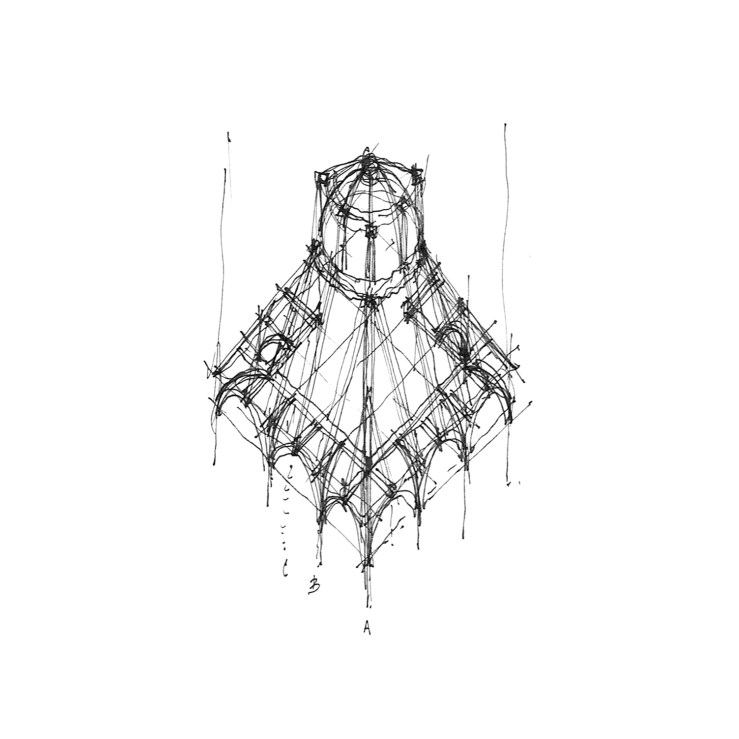
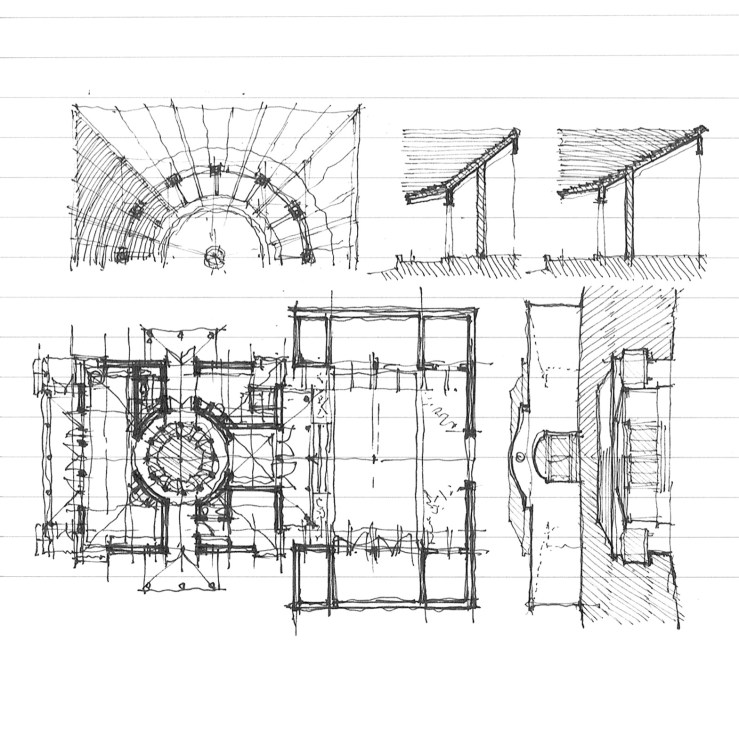
Continuing the formal explorations of the German hallenkirche typology of a few weeks ago, today I’ll share some more detailed takes: from a traditional half plan and section to oblique wormseye axonometrics and a section of the Brunelleschi-esque cupola with half a traditional oblique axon on one side and a womseye axon on the other.  These interrogations of representation are not just fun to draw, but actually aid in figuring out exactly how the timber roof is made up, and how that roof relates to the overall modular system.

square-church_08

square-church_09

square-church_11

square-church_10

square-church_07

a ranch home

ranch-house_02

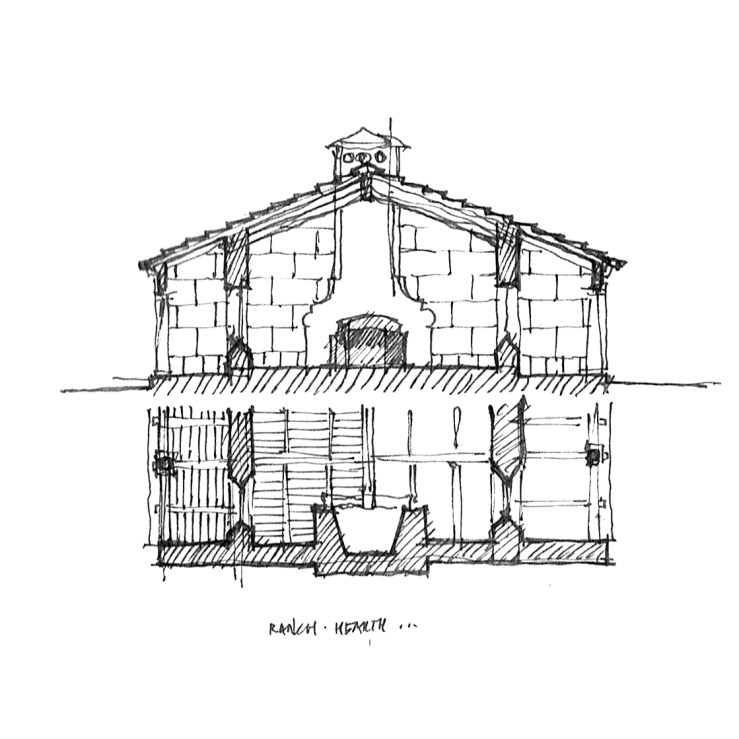
While studying for my latest licensure exam, I came across a simple section of a ranch-style home, which I couldn’t resist but take stab at.  The hearth above is the result of that drawing, and the plans below are the further explorations thereof.  The floorplan references Mies’ linear homes of the mid 1950’s (McCormick, 1952 & Greenwald, 1955), with a linear series of kitchen, dining, and living spaces separated by casework storage and toilet units, while long porches flank full-height doors.  Because my first plan neglected to include the bathroom in particular, the bottom sketch notes how the bath, murphy bed, and storage unit works out.

ranch-house_01

ranch-house_03

nine squares, a few circles, and a couple piloti

ionic-house_01

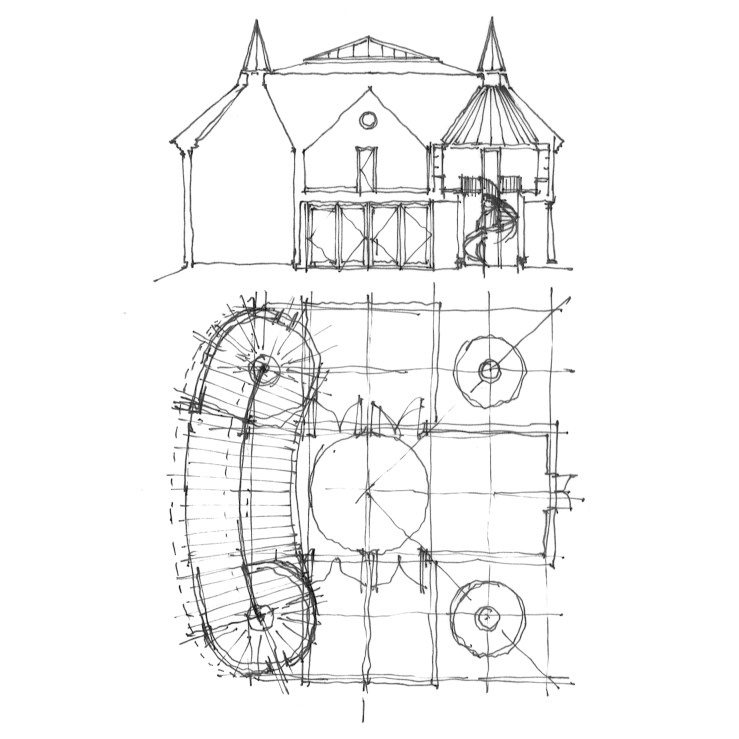
The story of where these ideas come from is a hodgepodge, so let’s just talk about what this is: a circular atrium in the middle of a nine-square plan demarcated with Corbusian piloti-cum-columns, with its four corners filled with circles: two circles are set up as objects, while two others are strung together with a larger radius.  All of this sits below a blank square volume, continuing the allusion to Villa Savoy, with a strong gable at the roof line.

ionic-house_02

ionic-house_03

ionic-house_04

churches and squares

SQUARE-CHURCH_03.jpg

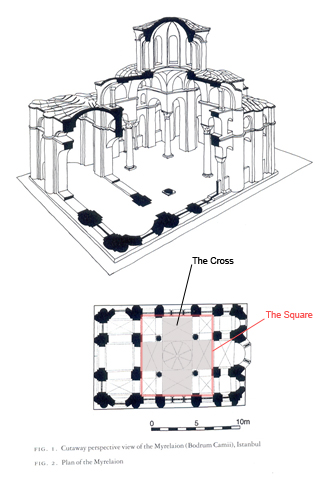
Most of the church forms I’ve featured have been basilicas – that is, long linear rooms with clearly defined axes and a higher central nave with lower side aisles.  But recently, I tried to reconcile my basilican interests with my predilection for squares.  Enter two historical church types based on the nine-square motif: the German hallenkirche (hall church), where there is no clear distinction between nave and aisles, but rather a large, open ‘hall’ of columns with extensive windows on all sides, and the Greek cross-in-squarein which a cruciform church plan is contained in a square form, with a large dome over the central crossing.  This project fuses the two, with an intense wood roof structure that attempts to read as both the hallenkirche and the cross-in-square in one, and goes even further to render the space as a cube.

square-church_02

square-church_01

porches, squares, and circles

porch-house_06

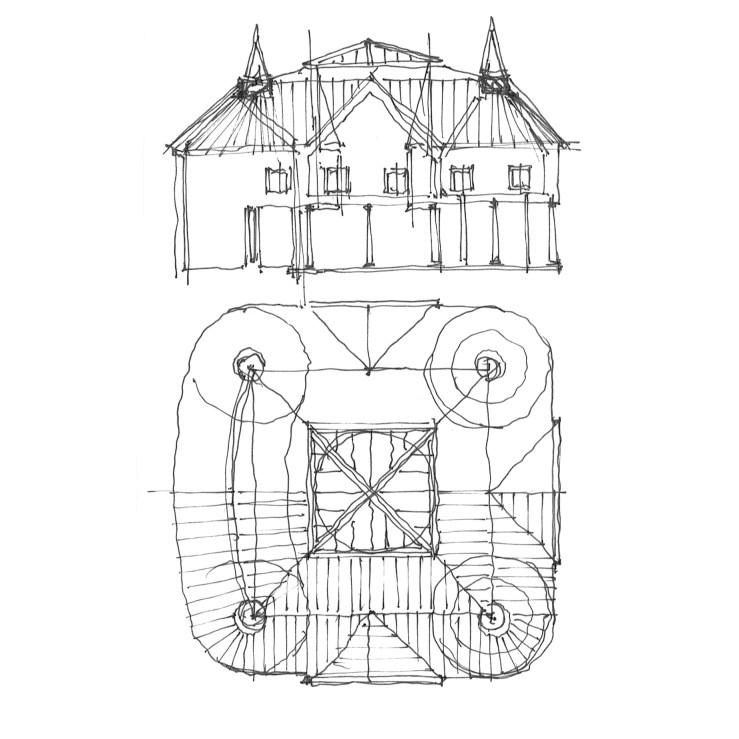
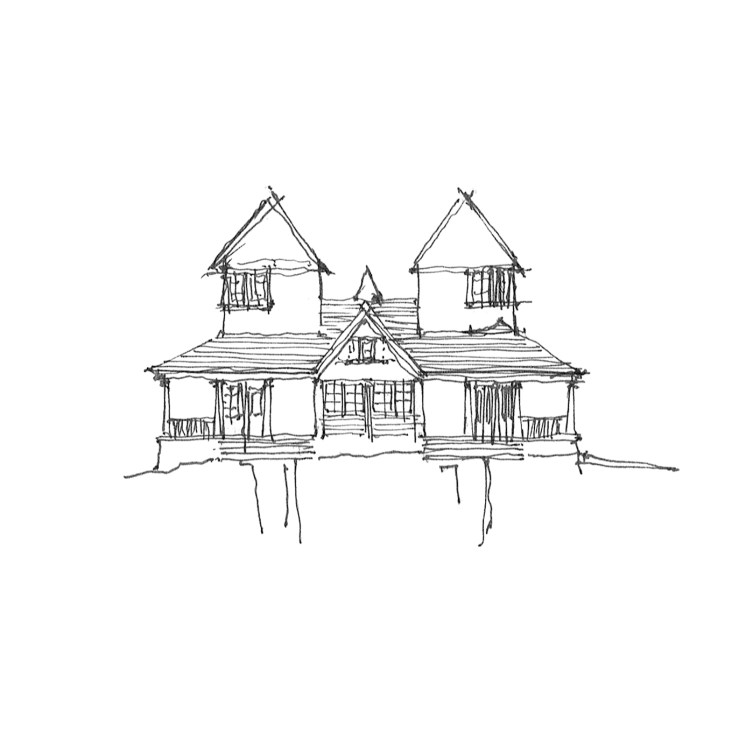
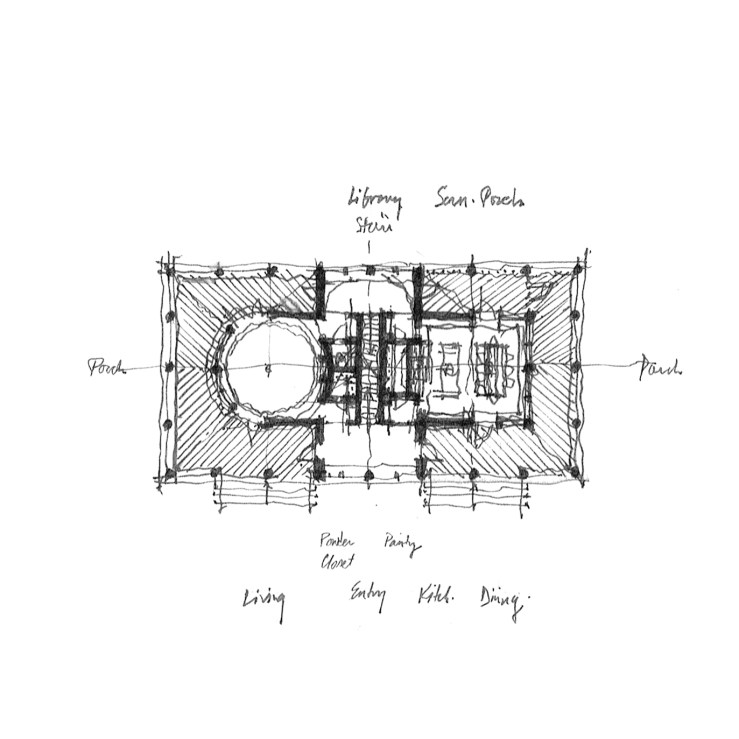
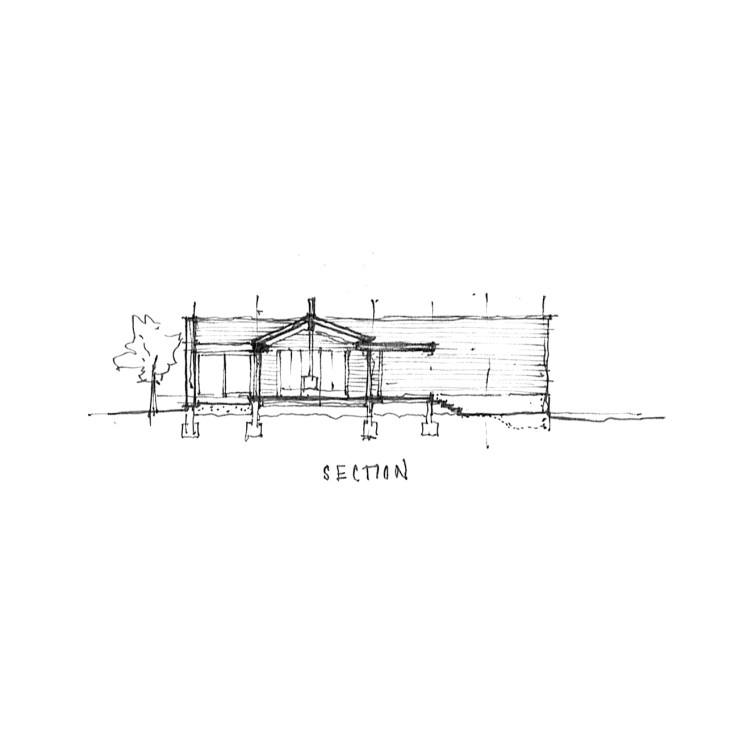
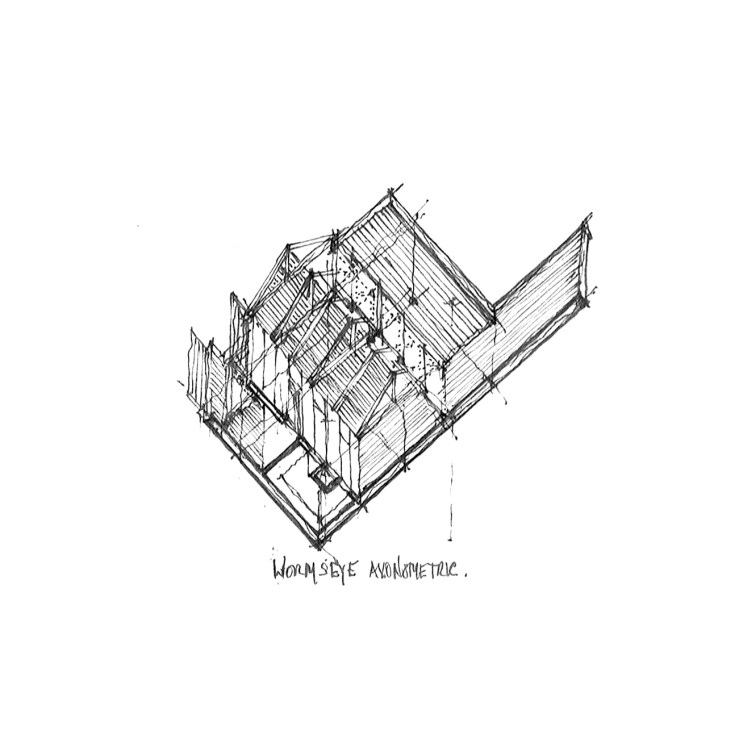
This project stems from a building I passed by every so often living in New Haven, CT.  Two or three Victorian and Colonial homes had been repurposed as a school, with one long porch wrapping all of the various buildings into one.  My proposal here places two opposite forms – one square, the other circular – against one another, united by a shared central staircase and a wrap-around porch, as one house with two identities.  The bottom elevation shows a variation, with a larger second floor and attic, but the basic idea is lost. . .

porch-house_04

porch-house_05

porch-house_07


a modern courtyard

courtyard-house_11

My brother is kind of infatuated with mid-century modernism, with volumes on Palm Springs and Neutra strewn about his house.  So naturally, I began to tinker with what I might do with the tropes of ‘MCM’, and how I might incorporate it into my own tendencies of modular, square plans.  This plan again plays on ideas of four and nine-squares, with brick walls surrounding three sides of a square, one half of which is dedicated to the interior domestic spaces and the other is given over to the exterior with a brick patio, wood deck, gravel garden, and a pool.  The timber-framed living volume is flanked by a service bar in which a small entry courtyard is situated.

I’m not happy with the pool, and am tempted to try it on center rather than the side. . .

courtyard-house_12

courtyard-house_13

a pantheon, of sorts

pantheon_01

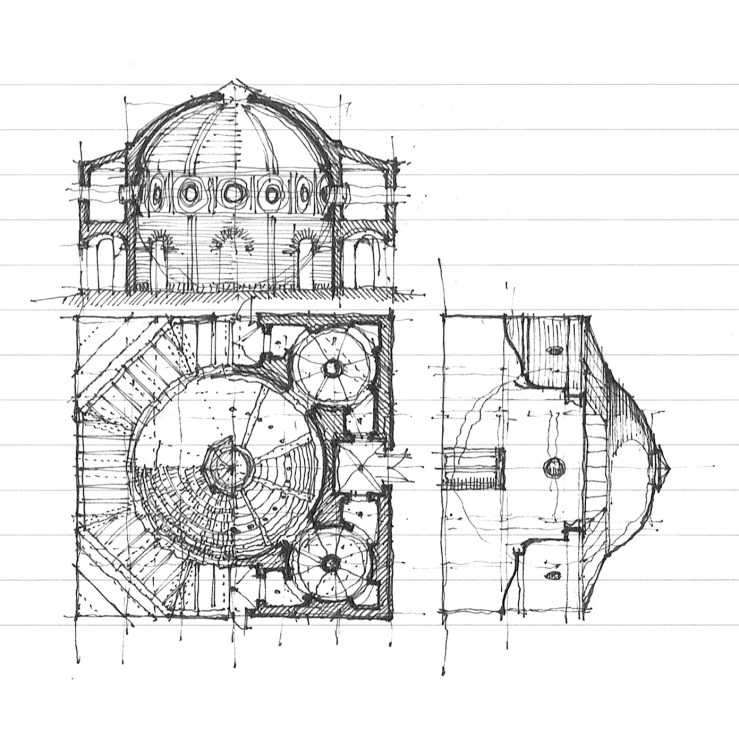
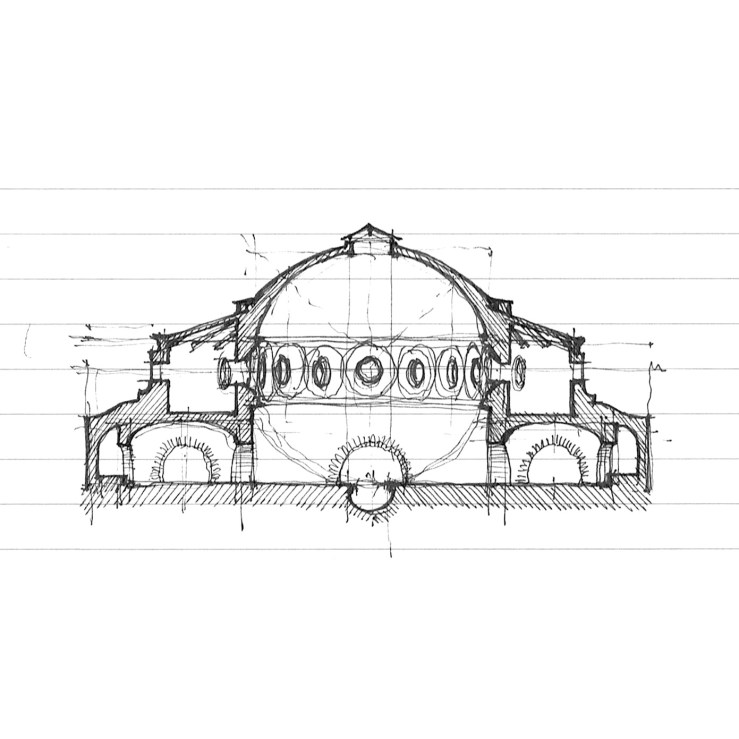
This project started as a half-cube, which then got its corners chamfered off to become an octagon.  It then had a large spherical central space carved out of its inside, in grand imitation of the archetypal Pantheon in Rome, but here rendered in simple brick, without the fuss of the Orders or coffers.  Typically, the entrance to a central sancto sanctorum like this is given directly from the outside, but this project forces one to ambulate first through smaller domes at the corners before entering the central space, which is shown in the diagonal section below.

pantheon_02

a courtyard in the desert

desert-courtyard_01

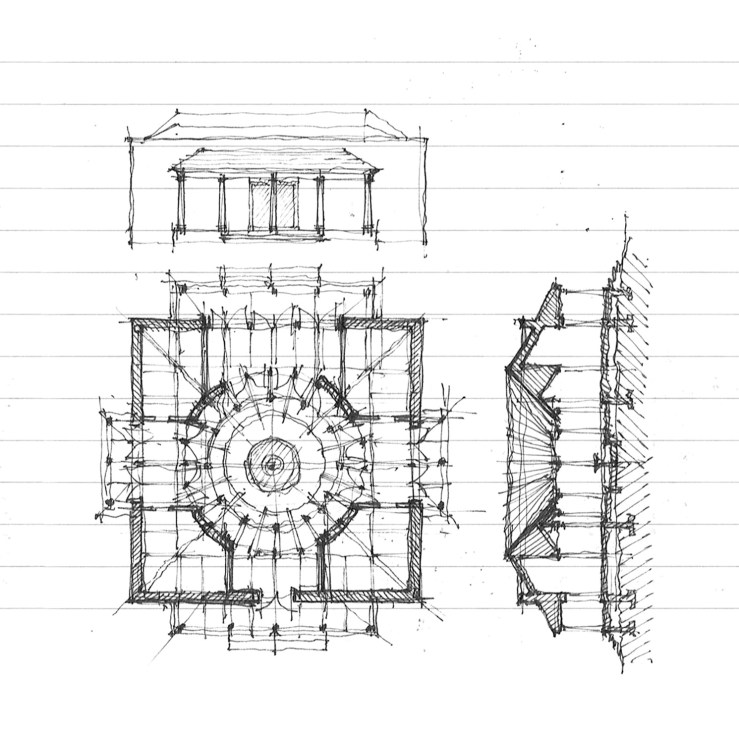
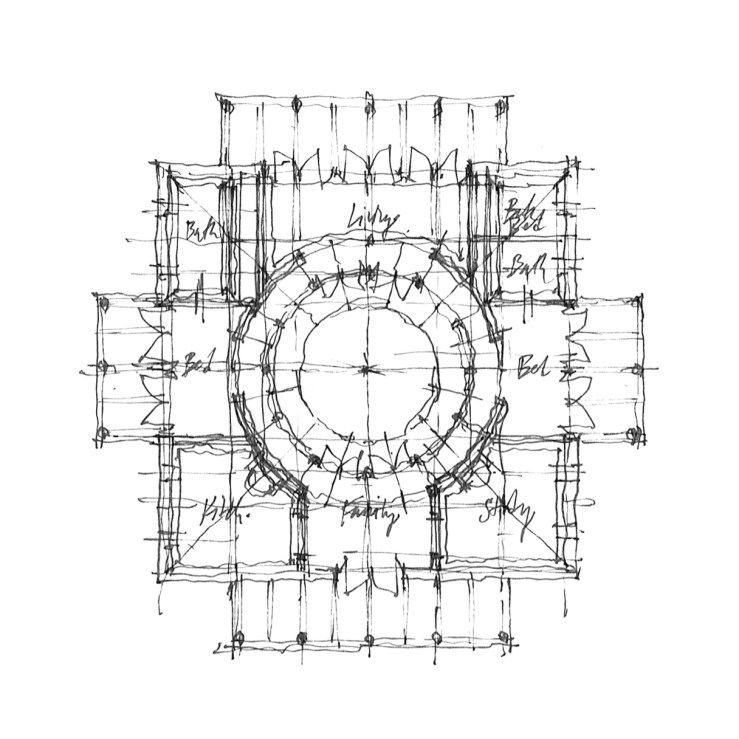
My brother-in-law lives in a small military town in the Mojave desert, and when he mentioned buying cheap land and building something, naturally I got thinking.  Courtyard typologies sprang to mind, perhaps met with elements of pueblo adobe rectangular masses and carved wood porches.  My plan offers a square adobe mass punctured with a circular courtyard and fountain at its center (evaporative cooling), and is rimmed with wood porches about to enjoy the expansive desert vistas, and to offer deep shade to any exterior openings.

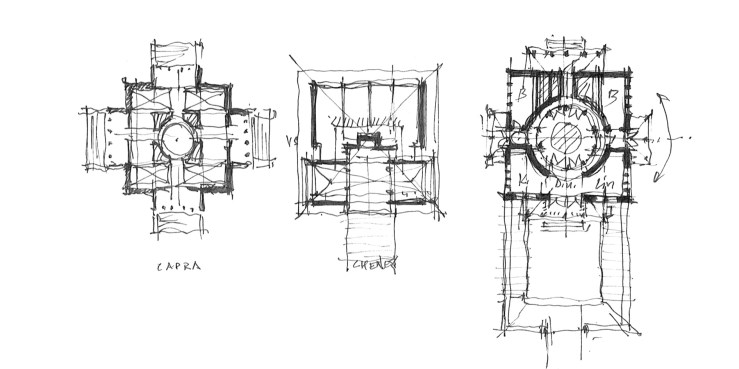
While traces of Irving Gill abound in the reductive classical-vernacular language, the plan geometries posed a small problem, reconciling the circular interior form and the division of rectangular rooms about.  I turned to Palladio’s Villa Capra (La Rotonda) for help, but also needed to situate the rooms of a modern single family residence, and thought Frank Lloyd Wright’s Cheney House might work.

desert-courtyard_02

desert-courtyard_03

desert-courtyard_04